

- Carl Brown
Four Pillars Shaping the Workplace Design of Today
For years, workplace design has been dominated by conversations about aesthetics, density ratios, and efficiency metrics. Yet despite beautifully finished offices and increasingly flexible WFH policies, many organisations continue to struggle with engagement, collaboration, and performance.
The issue is not a lack of investment, but a lack of understanding of the fundamentals.
At its core, the workplace is not simply a four walls container for work. It is a living ecosystem that shapes behaviour, energy, and the human experience. When that system is misaligned with how people think, feel, and interact, no amount of design embellishment will fix it.
What we are seeing across hybrid and post-pandemic workplaces is a shift away from surface-level solutions and towards a more fundamental question:
What do people actually need from a workplace to do their best work?
Drawing on contemporary workplace research, behavioural science, and human-centred design thinking, four interdependent forces consistently emerge. When these forces are balanced, workplaces thrive. When one is neglected, friction follows.
1. Workplace Design Foundations
Stability, Purpose, and Belonging
Effective workplaces begins with a sense of grounding. People need to understand where they fit, what is expected of them, and why their work matters. Without this clarity, even the most flexible or visually impressive office can feel unsettling rather than empowering.
Foundations are not about rigidity. They are about trust and clarity.
In spatial terms, this means:
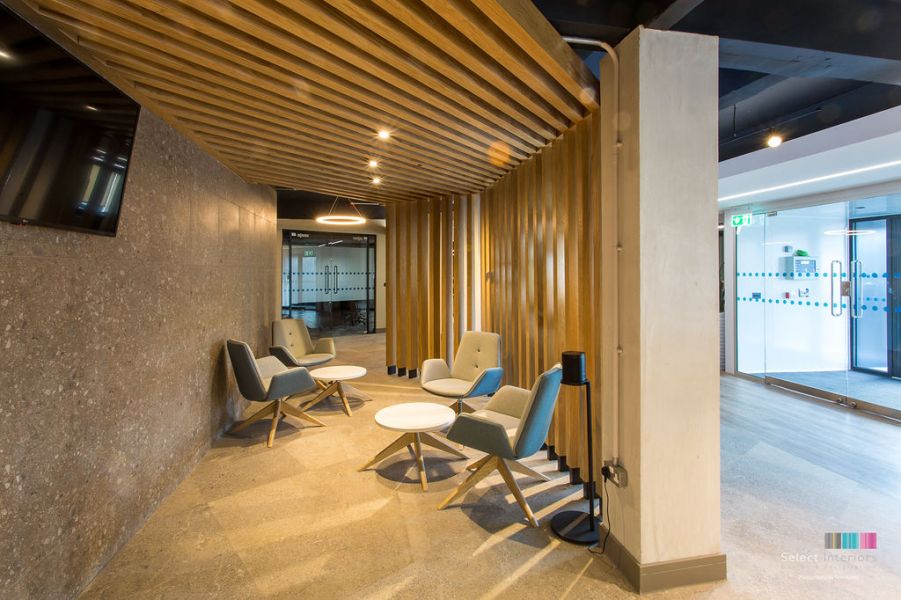
- Clear zoning and intuitive layouts
- Spaces that reflect organisational identity and values
- Environments that support focus, reliability, and consistency
When foundations are weak, people compensate through behaviour: desk hoarding, resistance to change, or disengagement. When they are strong, people feel confident to move, adapt, flex, and collaborate.
Crucially, foundations are cultural as much as physical. A workplace that communicates purpose through its design language, spatial hierarchy, and material choices reinforces stability in a world of constant change.
For organisations navigating hybrid working, this is critical. The office should not attempt to compete with home on comfort alone. It must offer something deeper: a shared sense of place, belonging, and meaning, supporting work, rest, and play.
2. Currents
Wellbeing, Flow, and Adaptability
Work is not linear. It ebbs and flows between focus and collaboration, intensity and recovery, structure, and autonomy. When workplaces fail to acknowledge this, people are forced to adapt themselves to the building, rather than the environment adapting to them.
Currents represent how work moves through people, mentally, physically, and emotionally.
Design responses that support healthy currents include:
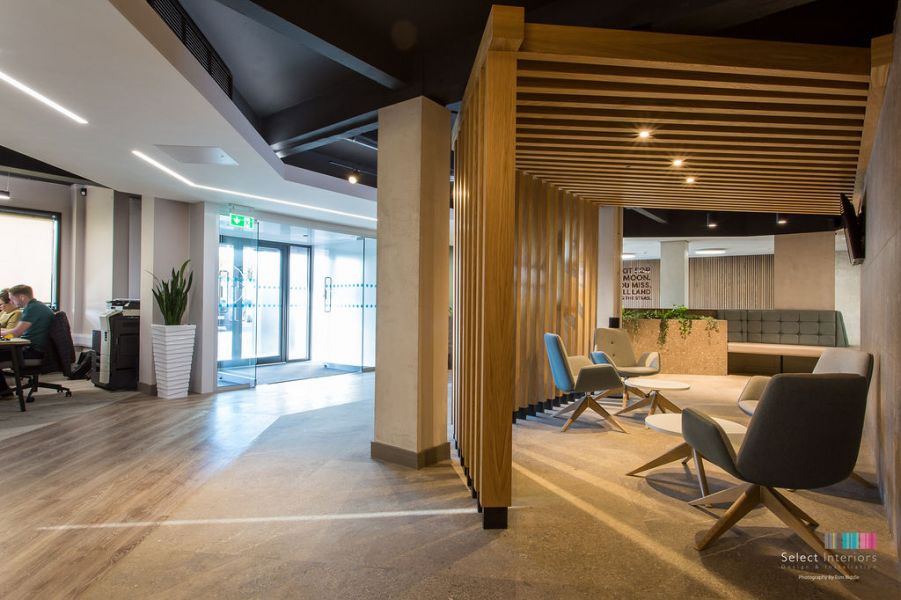
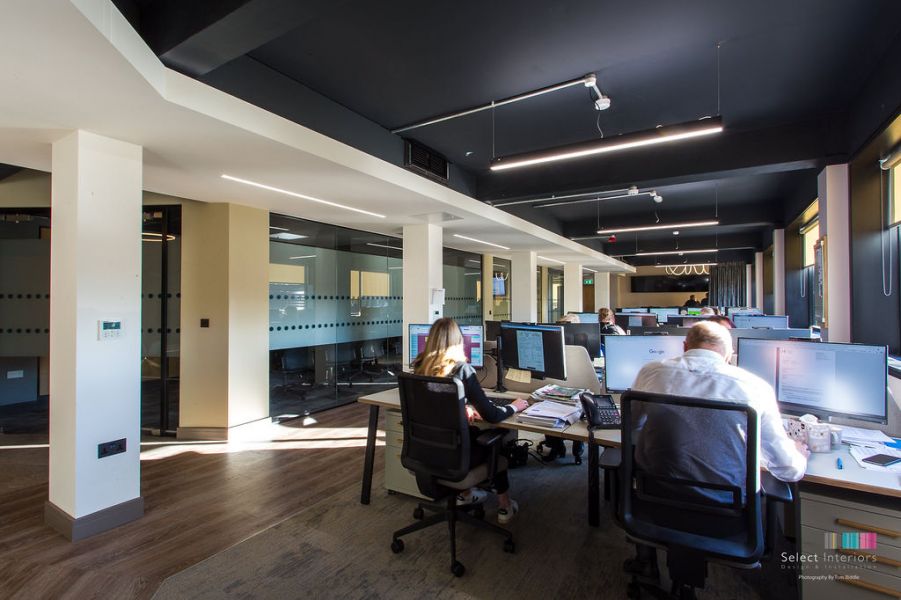
- A range of work settings, allowing people to choose environments that suit their task
- Thoughtful consideration of acoustics, light, and air quality
- Opportunities for movement throughout the day
Wellbeing is often treated as an add-on: a quiet room here, a plant wall there. In reality, wellbeing must be embedded within the space plan itself, not applied as a collection of design clichés.
When workplaces support flow, people experience:
- Higher sustained concentration
- Lower stress levels
- Greater autonomy and satisfaction
Adaptability is also a core component of wellbeing. Spaces that can flex with changing team sizes, project needs, and growth allow people to remain productive without constant disruption.
In this sense, a well-designed workplace behaves less like a fixed asset and more like a responsive environment.
3. Workplace Design Signals
Communication, Learning, and Cognitive Space
Workplaces are full of signals, visual, social, and cultural. Every space communicates something: who belongs, what is valued, how collaboration happens, and whether learning is encouraged.
Poorly designed offices overwhelm people with noise and distraction. Overly controlled environments suppress exchange, curiosity, and the informal “water-cooler” moments where connection and trust are built.
Signals are about how information flows, how it is shared, and how clearly it is received.
Effective workplaces provide:
- Visual and cultural openness
- Clear cues and wayfinding about how spaces are intended to be used
- Spaces that support both formal and informal knowledge sharing
Innovation rarely happens solely in scheduled meetings. It emerges through overheard conversations, spontaneous questions, and shared reflection.
At the same time, quiet space is essential. People need moments of calm to process information, think deeply, and make sense of complexity.
The challenge is not choosing between openness and privacy, but designing for both, and all the grey areas in between.
When signals are well balanced, workplaces feel legible rather than chaotic. People instinctively know where to go, how to behave, and when to engage.
4. Sparks
Energy, Motivation, and Creative Momentum
While stability and wellbeing are essential, they are not enough on their own.
Organisations also need momentum, the sense that ideas can ignite, progress is possible, and effort leads somewhere meaningful.
Sparks represent energy: motivation, creativity, and collective drive.
In spatial terms, this might include:
- Areas designed for collaboration and idea generation
- Environments that feel optimistic through colour, materiality, and messaging
- Moments of contrast and stimulation within the workplace
Energy, however, cannot be forced. Overstimulating environments quickly lead to burnout, while overly neutral spaces drain enthusiasm.
The most effective workplaces provide controlled intensity: places where teams can challenge one another and generate ideas, balanced with spaces for recovery and reflection.
When this balance is right, people do not just work efficiently. They feel invested.
Workplace Design Balance, Not Optimisation
A common mistake in workplace design strategy is optimisation in isolation.
One organisation prioritises wellbeing but neglects energy. Another drives collaboration at the expense of focus. A third creates beautiful spaces with no cultural grounding.
These forces are interdependent. Strengthening one while ignoring the others creates imbalance.
The role of workplace design is not to maximise a single outcome, but to create equilibrium, where stability, flow, clarity, and energy coexist.
As organisations rethink the purpose of the office, the question is no longer “How many desks do we need?” but:
What experiences should the workplace enable, that cannot happen elsewhere?
The Office as a Human System
At Select Interiors, we view workplace design not as a static environment, but as a living ecosystem shaped by people, culture, and behaviour.
Every design decision, from space planning to materials, lighting, and furniture, influences how people feel, interact, and perform. When those decisions are grounded in human needs rather than trends, the workplace becomes an investment in people, not just a bottom line cost.
As organisations continue to navigate uncertainty, one thing is clear: workplaces that truly work are not those that simply follow fashion or templates, but those that understand people.
And that understanding begins by recognising and balancing the fundamental forces that shape how we work.
Subscribe to our Newsletter
